Farmington Hills, MI · Garage Door Service
Garage Door Service for Dearborn Heights's 1958-Era Homes
Dearborn Heights homes mostly went up around 1958, years before Farmington Hills's typical build date. We drive the 11 miles out to work on the hardware that era left behind.
- Repairs & new doors
- Springs & openers
- Serving 5 nearby communities
What You Are Seeing
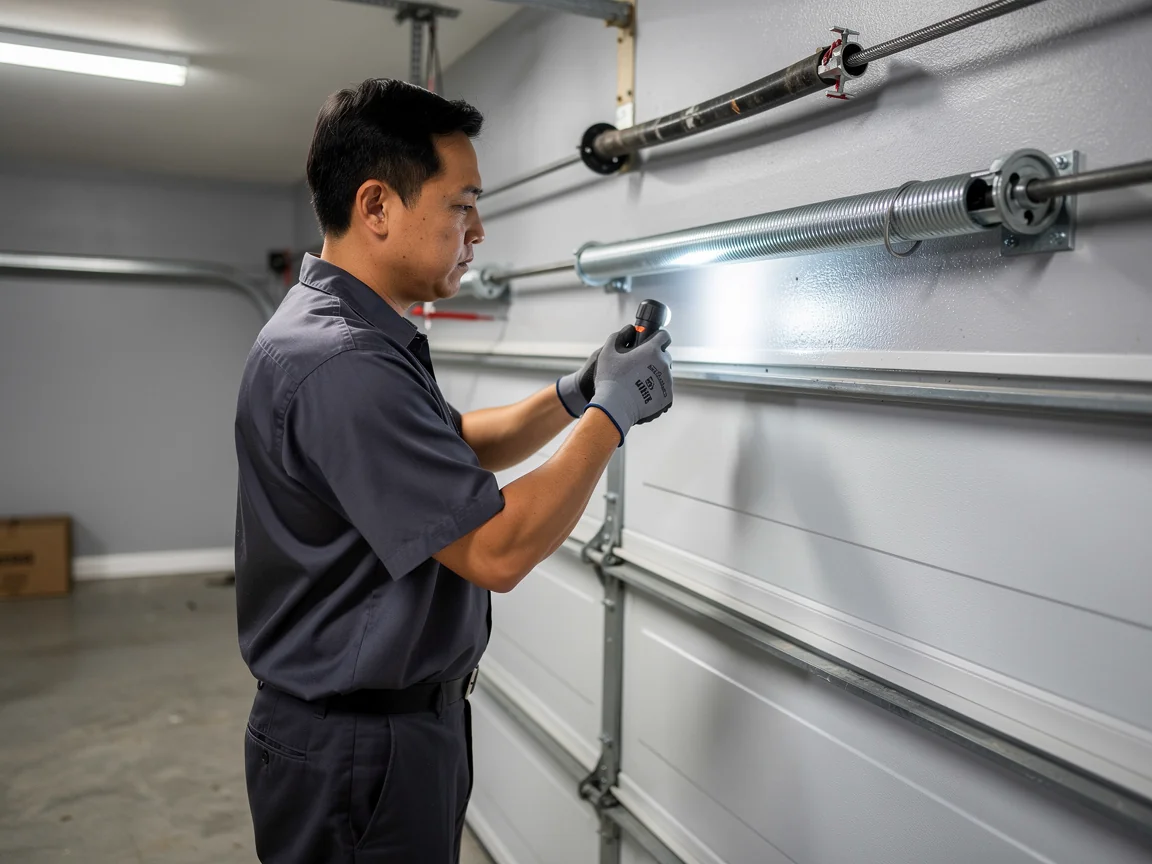
Most houses in Dearborn Heights went up around 1958, which puts this neighborhood on the earlier edge of the 1938-to-1991 build window we see across the wider service area. A door built or replaced in that era was almost always a single flat panel, hung on extension springs mounted over the horizontal track rather than the torsion springs standard on newer builds. If your door still has the original bones, you likely have a heavier panel than what ships today, riding on hardware that was never designed for the openers and safety cables now required.
What that means day to day: the spring doesn't fail quietly. Extension springs let go with a bang and can send a cable snapping sideways if it isn't threaded through a containment cable, which a lot of these older setups never had added. We see this pattern repeat across the neighborhood because so many houses were built in the same short stretch of years, with the same contractors buying the same hardware in bulk. It isn't a defect specific to any one home. It's the decade talking.
Why It Happens Here
Dearborn Heights sits in the same severe cold climate band as the rest of the area we cover, and that matters more on a 1958 door than a newer one. Steel panels from that era are thinner-gauge than anything made now, and decades of freeze-thaw cycling on the track and roller stems opens up play in the hardware faster than it would on a modern door. Add a household budget that, at a median of $61,035, runs noticeably below the $78,727 median across the broader service area, and you get a real pattern: deferred maintenance on original hardware instead of early replacement.
That's not a knock on the neighborhood. It's math. A full replacement competes with other repairs on a house that's now over sixty years old, so a lot of owners keep nursing the original door and opener along. The failure point is almost always the same: extension springs that have lost tension unevenly, rollers worn oval instead of round, and tracks that were never resquared after decades of seasonal movement. None of that is cosmetic. It's the stuff that turns into a dropped door or a jammed opener motor if it sits too long.
How Long It Takes
We run out of Farmington Hills, 11 miles from Dearborn Heights, so the drive is part of the job, not a separate line item. Spring and cable work on an original 1958-era door usually runs long once we're on site, since matching extension spring hardware to an old track means more setup than swapping a modern torsion spring. Opener work is often the complicating factor here too - a lot of these houses had openers retrofitted onto doors that were never drilled for one, so the mounting itself sometimes needs correcting before the opener install is even the issue.
Here's the honest limit: if the panel itself is rusted through or the track is bent beyond resquaring, patching it isn't worth your money. At that point we'll tell you replacement costs less over five years than another round of hardware repair, and we'd rather say that up front than keep billing you for a door that's done.
Stocked Parts
Across the 21,986 households in Dearborn Heights, the hardware we get called out for most is extension springs, roller sets sized for older flat-panel doors, and cable with containment loops added where the original install skipped them. We carry common sizes on the truck. What we don't always carry is panel stock for a specific original door - some of these 1958-era models used panel dimensions and hinge spacing that nobody manufactures anymore, which can mean a lead time if a single panel needs matching rather than a full door swap.
That's the one place where patience matters more than speed. We'll tell you on the first visit if your door falls into that category, so you're not waiting on a part we can't actually source.
Frequently asked questions
Why does my garage door spring keep snapping instead of just wearing out slowly?
If your house dates to around 1958, like most of Dearborn Heights, it likely has original extension springs rather than torsion springs. Extension springs fail suddenly rather than gradually, and without a containment cable, the broken spring or cable can whip. That's a hardware-era issue, not a sign you're doing something wrong.
Do you have a local branch in Dearborn Heights?
No. We run out of Farmington Hills, about 11 miles away, and drive out for every job in Dearborn Heights. There's no local depot or standing inventory in town, just what's on the truck plus what we stock back at the shop.
Is it worth repairing a door from the 1950s or should I replace it?
Depends on the panel. If the steel is intact and it's a spring, cable, or roller problem, repair makes sense. If the panel is rusted through or the original hinge spacing can't be matched anymore, we'll tell you replacement is the cheaper path over time rather than keep patching it.
More garage door services in Dearborn Heights
- Garage Door Cable Repair in Dearborn Heights
- Garage Door Repair in Dearborn Heights
- Garage Door Maintenance in Dearborn Heights
- New Garage Door Installation in Dearborn Heights
- Off-Track Garage Door Repair in Dearborn Heights
- Garage Door Opener Installation in Dearborn Heights
- Garage Door Roller Replacement in Dearborn Heights
Book garage door service in Farmington Hills
Call now or request a quote - tell us what the door is doing and where you are.