
Farmington Hills, MI · Garage Door Service
Safety Sensors and Why They Keep Drifting Out of Line
Why garage door safety sensors misalign in Farmington Hills homes built in the 1960s and 70s, how the area's cold winters make it worse, and what actually fixes it.
- Repairs & new doors
- Springs & openers
- Serving 5 nearby communities
What the Weather Here Does to It
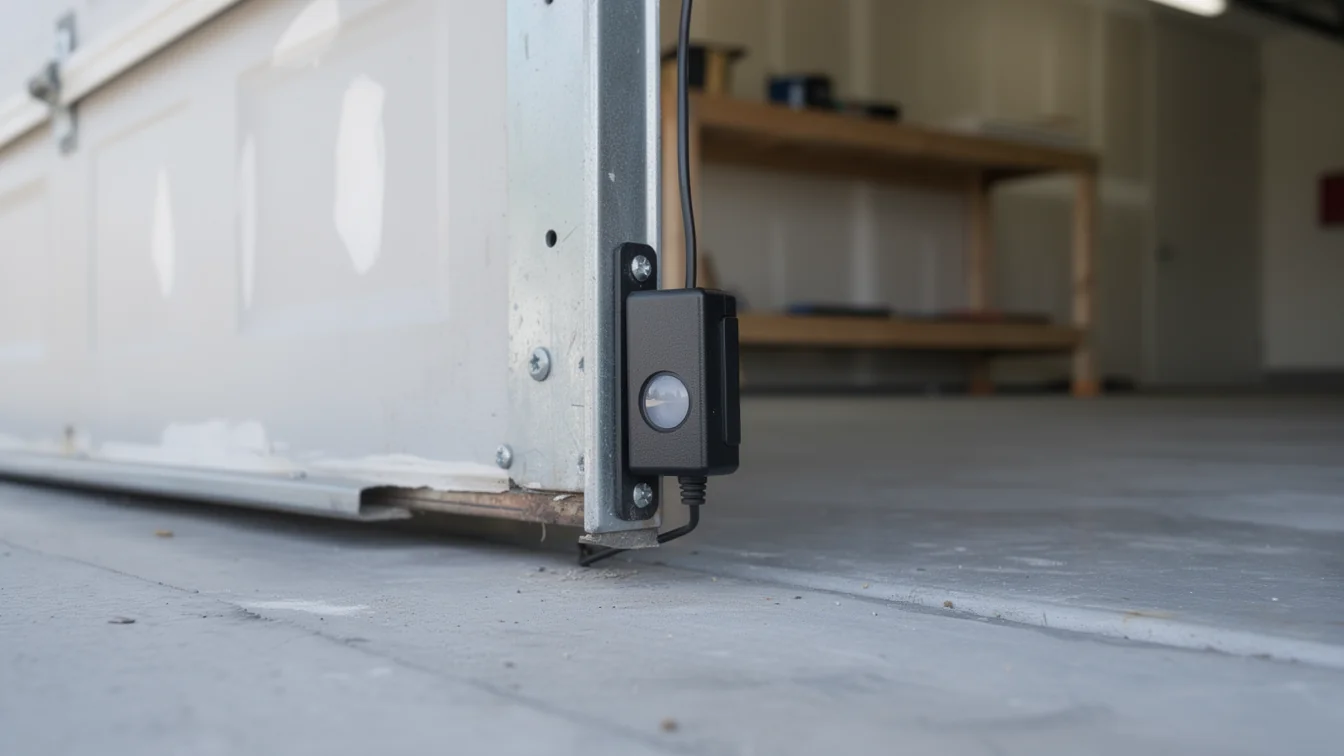
This area sits in a cold-severe climate band, which means the ground under a garage slab goes through real freeze-thaw cycling every winter, not just a cold snap or two. A slab doesn't move evenly. One side heaves a little more than the other, and if your sensor brackets are lag-bolted into that slab or into the jamb sitting on it, the whole bracket shifts a few degrees over a season. You won't see it happen. You'll just notice the door starts reversing for no reason, or the light blinks and the door won't close at all, usually right around the first hard freeze or the first real thaw. Road salt and the slush that opener tracks sit in all winter don't help either - they work into any bracket that was already a little loose and speed up the drift. None of this is a defect in the sensors themselves. They're doing exactly what they're built to do: stop if the beam isn't lined up. The problem is the structure around them moving underneath a part that has zero tolerance for being even slightly off-axis.
Leaving It Alone
A lot of houses in this part of town went up between 1960 and the early 90s, with the median build year sitting around 1960, and that older stock usually has sensors mounted on whatever jamb material was standard at the time - often wood, sometimes thin aluminum, rarely anything as rigid as what gets installed now. Wood jambs cup and twist with humidity and cold over decades. If nobody's touched that bracket since it went in, it's had thirty or forty winters to work its screws loose a sixteenth of a turn at a time. Ignore a drifting sensor long enough and the failure mode isn't gentle - the door stops closing fully, or it closes and reverses halfway, which people often blame on the opener logic board instead of the two small eyes down at ankle height. Left alone, loose brackets eventually let the beam miss by enough that the safety feature stops working as a safety feature at all. That's the part worth not ignoring, even though it's easy to.
The Situation
Across the service area there are roughly 150,321 owner-occupied houses sitting on housing stock that's mostly 1960s and 70s construction, and sensor drift tied to bracket and jamb movement is the single most common service call we get that isn't a broken spring. With median household income here around $78,727, most owners we talk to want the sensor re-aligned and re-secured rather than the whole opener replaced, and for most of these houses that's the right call - the opener unit itself is rarely the problem. Where it gets more involved is a jamb that's rotted or split enough that a bracket won't hold a screw anymore. At that point you're not re-aligning anything, you're rebuilding the mounting point first. That's a different job and a longer one, and it's worth knowing the difference before you call someone out expecting a five-minute fix.
Where People Go Wrong
The most common mistake is wiping the sensor lenses and calling it fixed. That solves the problem maybe one time in five - usually it's alignment, not dirt. The second mistake is tightening the wing nut on the bracket without checking whether the bracket itself has pulled loose from the jamb behind it; a tight wing nut on a loose bracket just means the whole thing drifts again next freeze. The honest limitation here: we don't recommend re-shimming a bracket into a jamb that's already soft or rotted from decades of moisture. At that point the fix won't hold through another winter cycle, and the right move is replacing the section of jamb, which is carpentry work, not a sensor adjustment. We'll tell you when that's what you're looking at instead of patching it and having you call back in March.
Frequently asked questions
Why does my garage door sensor only act up in winter?
Cold-severe freeze-thaw cycling moves the slab and jamb under the brackets a little each season. The sensors themselves aren't temperature-sensitive, but the mounting points they're bolted to shift with the ground, which throws off the alignment right when the weather turns.
Can I fix a drifting sensor myself?
Often yes, if the bracket and jamb are solid - loosen the wing nut, realign the eyes so both lights go steady, and retighten. If the jamb is soft, rotted, or the bracket won't hold a screw, that's a repair job first and a sensor adjustment second.
Is sensor drift a sign I need a new opener?
Usually not. On most of the 1960s and 70s-built houses in this area, the opener logic is fine - it's the mounting hardware or jamb underneath the sensors that's moved. Replacing the opener rarely fixes a problem that's structural, not electronic.
Related garage door services in Farmington Hills
More garage door guides
Book garage door service in Farmington Hills
Call now or request a quote - tell us what the door is doing and where you are.