Farmington Hills, MI · Garage Door Service
Garage Door Opener Installs Built for Farmington Hills Homes
Opener installs for Farmington Hills houses built mostly between 1938 and 1991, where cold winters and original hardware wear out openers the same way, house after house.
- Repairs & new doors
- Springs & openers
- Serving 5 nearby communities
What You Are Seeing
If the opener is grinding, reversing itself halfway up, or the light blinks and nothing moves, you're not imagining it getting worse every month. Across this service area, houses mostly went up between 1938 and 1991, with the median build year sitting around 1960. That means a big share of homes still have a chain-drive opener from decades back, often the second or third unit since the house was built, bolted to track and a spring setup that predates the opener itself.
The symptoms show up the same way almost everywhere: the motor runs but the door doesn't move (worn gear), the door reverses right before it closes (bad limit settings or a dying sensor), or the remote works some days and not others (a failing circuit board). None of that is dramatic. It's just an old motor doing what old motors do after enough winters.
What's different here is the cold. Severe cold winters are hard on the capacitor inside an opener motor, and that part tends to go before the gear does. So you'll often see an opener that looks fine on the bench fail the first cold morning of the season. That's not bad luck - it's a predictable failure tied to the climate band this area sits in.
Booking a Visit
We handle opener installs across the whole service area - 288,662 households and 150,321 owner-occupied houses, spread across 41 named communities including places like Franklin, Bingham Farms, Walled Lake, and Northville. When you call, we ask the make of your current opener if you know it, whether the door is single or double, and whether you've got battery backup already - that tells us which unit to bring instead of guessing on-site.
Most visits are scheduled, not same-day emergency calls, since an opener swap is planned work, not a broken-spring crisis. We'll give you a window, not an exact minute, because the job before yours sometimes runs long on an old bracket that won't come loose clean.
One thing we're upfront about: if your track or spring setup is original to a house from the 1960s, we may need to source a bracket or rail adapter that isn't sitting on the truck. That can push a same-week job to the following week. We'd rather tell you that now than have you waiting on a truck that's stuck at the last stop.
More about the company and our full range of work is on the home page, not here - this page is just about getting an opener installed right.
What the Repair Takes
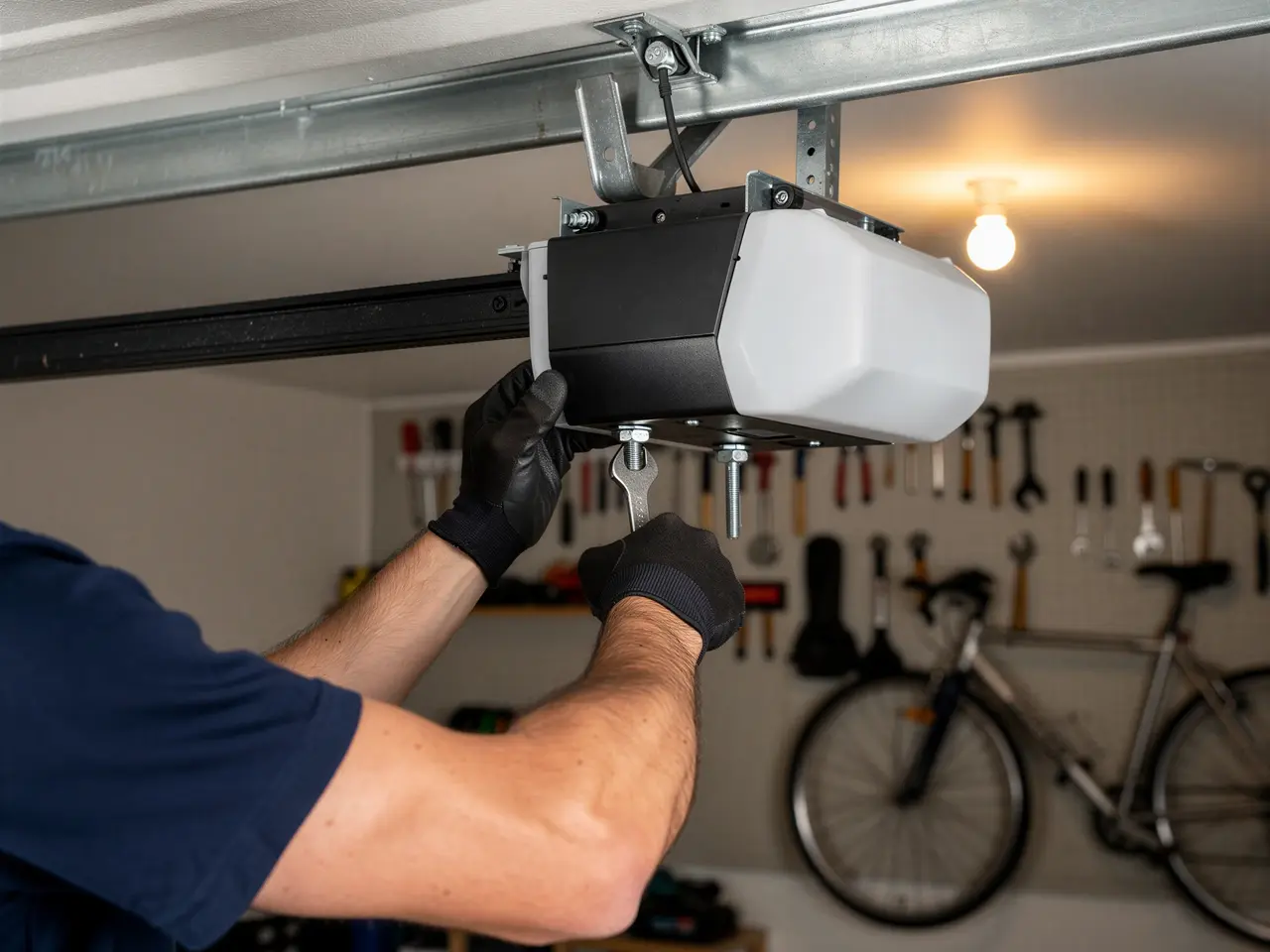
A straight swap - same drive type, same mounting points - usually runs under two hours. Chain to belt, or adding battery backup to a house that's never had it, takes longer because we're re-running wiring and resetting travel limits and force settings from scratch, not just unbolting one box and bolting on another.
The honest limitation: if the door itself is original - a one-piece slab or an old sectional door with side-mounted torsion hardware from the 1960s - a modern opener can still bolt to it, but it won't fix the door's own wear. We'll say so before we install rather than let you think a new opener solved a problem the door still has. Sometimes the right call is replacing the door at the same time; sometimes it's fine to wait a year.
We set the opener's force and travel limits by hand for every install, since a unit calibrated too tight will reverse on cold mornings when the metal contracts, and one calibrated too loose won't catch an obstruction. We also test the backup battery under load before we leave, not just plug it in and assume it holds - batteries that look fine on a shelf sometimes don't hold a door's weight once the power actually drops.
Why It Happens Here
This isn't a generic wear-and-tear story. Across the 41 named areas in this service territory, the housing stock clusters tightly in the 1960s and 70s, with the overall range running from 1938 to 1991 and a median year right around 1960. That concentration matters because openers from that era, and even the replacements installed in the 80s and 90s, are now at or past the end of their working life at roughly the same time across whole blocks.
Layer the climate on top of that. This region sits in a severe cold band, and cold is specifically hard on the motor's capacitor and on any nylon drive gear that's already brittle with age. An opener that's merely old in a mild climate might limp along for another few years; the same opener here tends to fail on the first real cold snap, because the metal and plastic components contract and the strain finally finds the weak part.
With a median household income of $78,727 across the area, most owners here are in a position to upgrade to a belt-drive opener with battery backup rather than patch a chain-drive unit that's already on its second motor. That's less about preference and more about the math working out over the house's remaining years.
Frequently asked questions
How do I know if I need a new opener or just a repair?
If the motor runs but the door barely moves, or the unit is making a grinding sound that's new in the last month, that's usually a gear or capacitor issue worth repairing. If it's failing intermittently across multiple parts - remote, sensor, and motor all acting up - replacement is usually the better money.
Will a new opener work with my old garage door?
In most cases yes, a modern opener bolts to an older door's existing track and header bracket without a problem. The exception is a door with side-mounted torsion hardware from the 1960s, where the bracket itself sometimes needs an adapter we may not carry on the truck that day.
Why does my opener always fail in winter?
Cold is hard on the capacitor inside the opener motor and on aging nylon gears, both of which get brittle with repeated freeze cycles. In a severe cold climate like this one, an opener that's already near the end of its life tends to go out on the first hard cold snap rather than failing gradually.
Do you install battery backup openers?
Yes, and if your house has never had one, the install takes a bit longer because we're running new wiring and testing the battery under actual door-weight load before we leave, not just confirming it powers on.
Related guides
By Neighborhood
Opener Installation across the Farmington Hills area
We also handle opener installation in these Farmington Hills-area suburbs.
Book garage door service in Farmington Hills
Call now or request a quote - tell us what the door is doing and where you are.