
Farmington Hills, MI · Garage Door Service
Why a Door Goes Off Track in Farmington Hills
Farmington Hills homes built mostly in the 1960s-70s face cold-climate stress on original track hardware. Here's why doors jump track and what actually fixes it.
- Repairs & new doors
- Springs & openers
- Serving 5 nearby communities
What the Weather Here Does to It
Most of the housing stock around here went up between 1938 and 1991, with the median sitting around 1960, so a lot of these garages still have track hardware that's decades old. In a severe cold climate like this one, that matters more than people think. Steel track contracts in deep cold, and the mounting brackets holding it to the framing do too - but not at the same rate as the wood or the slab they're bolted to. Over enough winters, that mismatch works the bolts loose a sixteenth of an inch at a time. You won't see it happen. You'll just notice one day that the rollers are riding the edge of the track instead of the middle. Add the freeze-thaw cycle that's normal for this band of Michigan, and the ground under a garage slab shifts slightly every year. If the track is anchored to jamb framing that's settled even a little, the two vertical tracks stop being perfectly parallel. A door can run fine for years on track that's slightly out of true and then jump the rollers the first time a spring loses tension or a cable stretches. The cold doesn't cause the problem by itself. It just accelerates whatever was already a little off.
Leaving It Alone
A door that's just barely off track - rubbing, a little noisy, maybe one roller riding high - will often still open and close for a while. That's the trap. Every cycle it runs misaligned wears the roller groove a little more and stresses whichever bracket is taking the extra load. In homes built in the 1960s-70s era that make up most of this area's housing, those brackets are frequently the original ones, sized for the door and spring weight of that time, not for a heavier insulated replacement door installed later. Running a misaligned door on old brackets is how you turn a five-minute track adjustment into a bent track, a pulled-out jamb bracket, or a cracked panel where the roller stem punched through. None of that is dramatic until the day the door comes off the track entirely, usually with someone's car underneath it. I'm not going to tell you every noisy door is an emergency - most aren't - but a door that's visibly leaning or scraping one side of the opening is not a wait-and-see situation.
The Situation
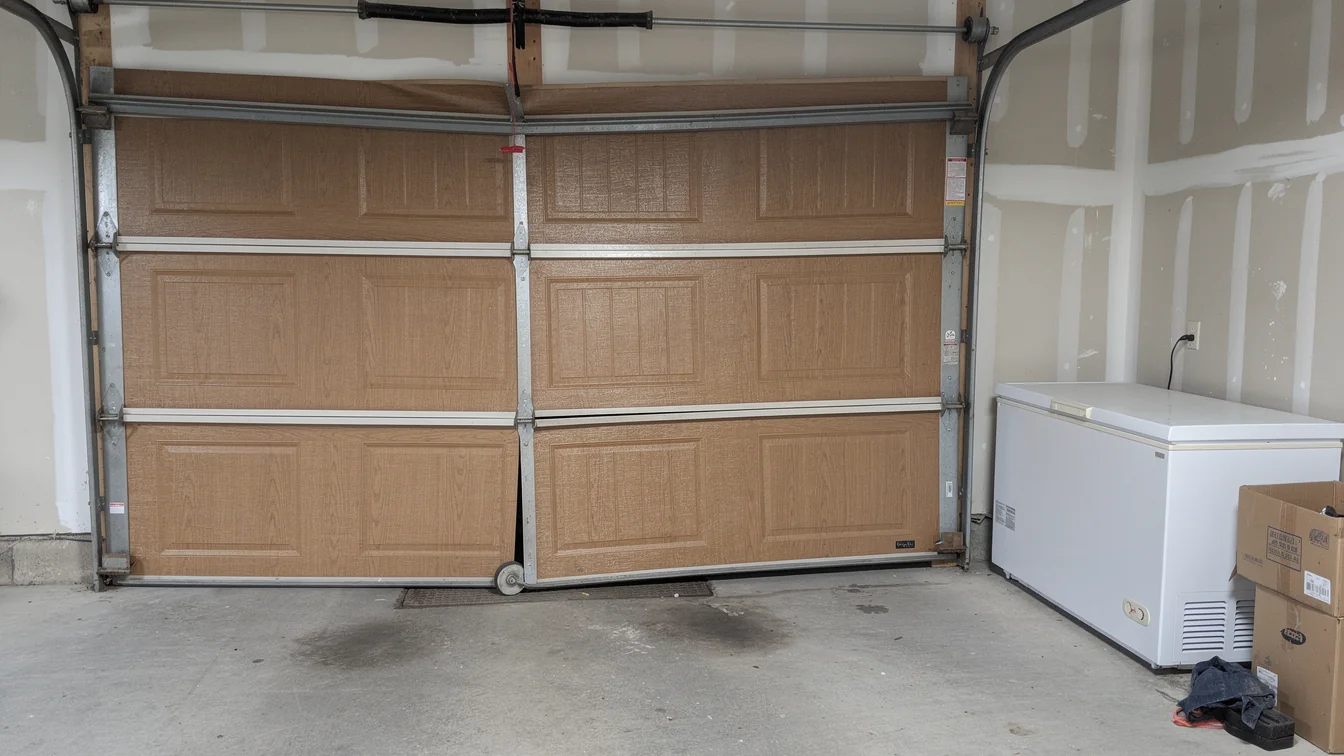
When we get a call about a door off its track in this area, it's usually one of two things. Either the hardware is original or close to it - consistent with a house from that 1938-1991 build range - and decades of seasonal movement have finally pulled a bracket far enough that the track geometry is wrong. Or the door itself was swapped out at some point for something heavier without anyone touching the track, springs, or brackets underneath it, so the new door is working harder against old hardware every single cycle. Both show up the same way: a roller that won't stay seated, a door that binds on one side, or a track that's visibly bowed near a bracket. The fix depends on which one it is. Sometimes it's a track alignment and a couple of new brackets. Sometimes the track is fine but the spring tension is wrong for the door's actual weight, which puts uneven pressure on the rollers every time it runs. We don't guess at that from the driveway - it means putting a level on the track and checking what the door actually weighs against what the springs are rated for.
Where People Go Wrong
The most common mistake is trying to force a door back onto the track by hand while it's under spring tension - that's how people get hurt, and it rarely fixes the actual alignment problem anyway. The second mistake is replacing rollers and calling it done when the real issue is a bracket that's pulled away from framing that's shifted with the seasons, which is common enough in houses from this area's older stock. A new roller on a crooked track just wears out faster. I'll also say plainly that if the track, hinges, and brackets are all original to a house from the 1960s, and more than one section is bent or rusted through, realigning it is sometimes a losing bet - you're better off replacing that hardware outright rather than fighting it every winter. We'll tell you when that's the case instead of running up a bill on parts that'll be back off track again in a year.
Frequently asked questions
Why does my garage door only jump the track in winter?
Cold makes steel track contract and can tighten the gap between the track and worn rollers, exposing play that's less noticeable in warmer months. In a severe cold climate like this one, that seasonal swing happens every year, and it's usually the final push on hardware that was already slightly misaligned from age or settling.
Is it safe to drive with a door that's partly off track?
No. A door riding off its track can drop suddenly or come free of the opening entirely, especially under spring tension. If a roller isn't seated in the track, treat the door as closed and call for a look before running it again.
My house is older - is that why the track keeps slipping?
It can be. A lot of homes in this area date to the 1960s and 70s, and original brackets and track were sized for the door and spring setup of that era. Decades of seasonal shifting plus a heavier replacement door can leave the original hardware working harder than it was built for.
Can I just tighten the bracket bolts myself?
You can check that they're snug, but if a bracket has pulled away from the jamb framing, tightening the bolt into stripped wood won't hold. That usually needs a new bracket set and sometimes a shim or backing to get a solid anchor point again.
Related garage door services in Farmington Hills
More garage door guides
Book garage door service in Farmington Hills
Call now or request a quote - tell us what the door is doing and where you are.